The Illusion of Progress
The market does not reward raw effort; it rewards outcomes. Yet, most teams drown in operational noise because they mistake motion for progress, treating every incoming request with identical urgency. Reflecting on my previous work on The Power of Intentional Value and The Automation Threshold, a critical truth becomes undeniable: we must constantly, ruthlessly challenge our to-do lists.
True optimization requires moving beyond basic triage to filter every commitment through a strict value lens. This is the urgency trap – a cycle of constantly fighting fires just to survive the day. When everything is a priority, nothing is.
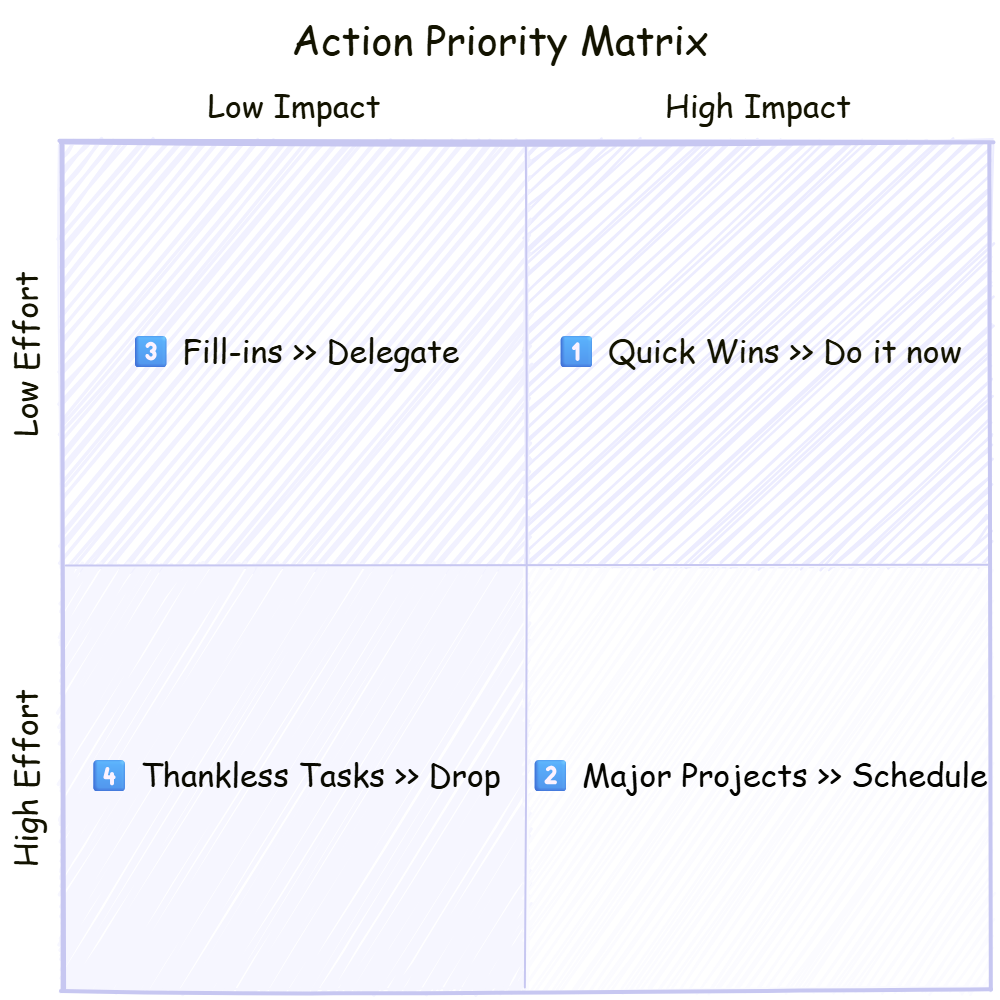
To break this loop, we rely on the Action Priority Matrix. Adapted from the core logic of the Dwight D. Eisenhower’s Decision Principle1 and later popularized by Stephen Covey’s urgency-importance framework2, this framework shifts our focus away from mere urgency. Instead, it forces an uncompromising focus on what truly moves the needle: maximizing high-value, high-impact tasks that require low effort.
The Anatomy of the Grid
To stop drowning in backlogs, you must view every task through a two-axis reality check: Impact (the value generated) against Effort (the time, cost, and complexity required). This creates four non-negotiable quadrants:
- 1️⃣ Quick Wins (High Impact, Low Effort): Mission-critical tasks executed immediately to build momentum and realize rapid returns.
- 2️⃣ Major Projects (High Impact, High Effort): Strategic initiatives requiring disciplined planning, clear timelines, and dedicated resources.
- 3️⃣ Fill-ins (Low Impact, Low Effort): Low-stakes tasks to batch, delegate, or complete only when excess capacity allows.
- 4️⃣ Thankless Tasks (Low Impact, High Effort): Black holes of productivity that yield minimal returns and must be systematically deleted.
The Drivers Behind the Strategy
Eliminating analysis paralysis3 requires replacing subjective intuition with objective, visible trade-offs. This framework forces teams to maximize resource ROI by funneling human capital and budgets exclusively into high-leverage activities.
Historically inspired by Eisenhower Matrix1 and Covey’s urgency-importance framework2, the matrix has evolved into a dedicated value-cost tool. It is championed today by product managers sequencing feature roadmaps, operations leaders triaging systemic workflows, and cross-functional stakeholders who need to resolve conflicting departmental priorities without emotional bias.
Execution over Intuition
This framework is built for a repetitive, dynamic loop – leveraged weekly for individual workflows and monthly or quarterly for broader business units. The trigger point to use it is clear: the moment your backlog expands past your actual execution capacity.
The operational mechanism requires strict discipline across five steps:
- Conduct a brain dump: Catalog every single initiative, feature, or task without filtering.
- Assign numeric scores: Score each item from 1 to 10 for both potential impact and estimated effort.
- Plot the coordinates: Map the items onto the matrix based on their designated scores.
- Execute by quadrant rules: Attack Quick Wins, scope Major Projects, delegate Fill-ins, and terminate Thankless Tasks.
- Audit regularly: Review the matrix dynamically as market demands or operational capacities change.
The Bottom Line
Implementing this strategy costs zero software acquisition dollars, yet failing to utilize it costs organizations hundreds of wasted hours on low-value labor. A structured team alignment session requires less than 60 minutes.
The Action Priority Matrix works because it introduces objective boundaries to an otherwise chaotic workspace. If your team is exhausted but hitting zero milestones, you are hoarding Thankless Tasks. Draw a definitive line between profitable execution and expensive distraction.